Men die, on average, 4 years earlier than women—largely due to preventable causes, which means it doesn’t have to be that way. (1) Small changes can lead to a stronger, healthier you. Living longer starts with simple, powerful habits.
That’s why Movember, also known as Men’s Health Awareness Month, is about more than just growing a moustache. It’s a global, annual campaign that encourages men to talk openly about their health, seek support, and take an active role in looking after themselves.
Changing Men’s Health Forever
Movember started in 2003, when two Australian friends, Travis Garone and Luke Slattery, were enjoying a casual beer when they joked about reviving the moustache as a fashion trend. Inspired by a friend’s mother, who was fundraising for breast cancer, they decided to turn their playful idea into a campaign for men’s health. They sent an email titled “Are you man enough to be my man?” and gathered 30 friends willing to take on the challenge. (2)
Today, this truly global movement brings together more than 5million participants and has funded more than 1,250 men’s health projects worldwide, focusing on three key health challenges: mental health and suicide prevention, prostate cancer, and testicular cancer. (3)
The result? Men now live longer, healthier, and more aware lives.
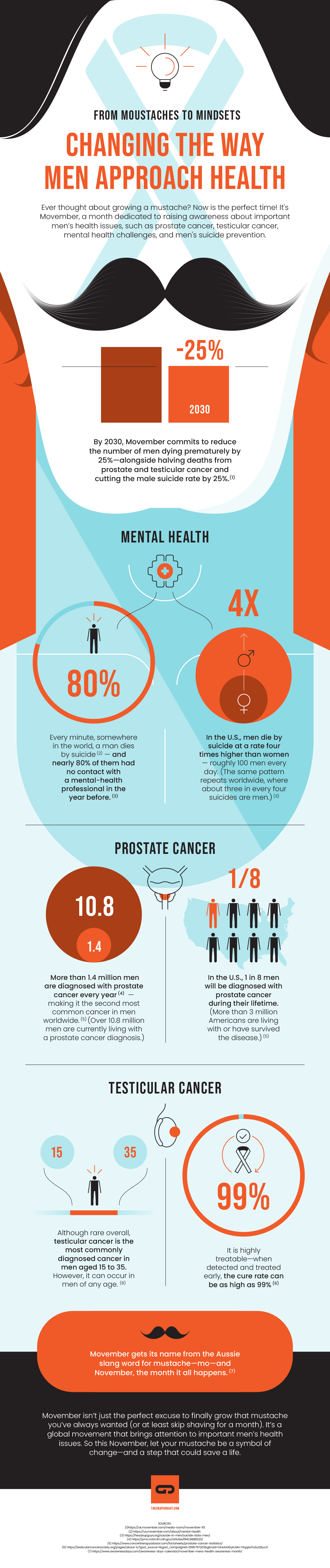
Infographic design by Boris Benko
Game-Changing Habits That Actually Work
Surround Yourself with Uplifting People
Your inner circle matters. Spend time with those who support, challenge, and inspire you. A quick call, a coffee catch-up, or even a group chat can go a long way in keeping your mental health on track.
Open Up More
Real strength lies in vulnerability. Be the guy who listens—and talks. Whether you’re checking in on a friend or opening up about your own struggles, emotional honesty builds stronger connections and supports mental well-being.
Stay Informed About Your Health
Don’t leave it to chance. By age 50, talk to your doctor about prostate cancer screening and whether a PSA test is right for you. If you have a family history—or are of African or Caribbean descent—start at 45. (4)
Know What’s Normal for You
Your body sends signals—so pay attention. If something feels off, get it checked. Staying aware of changes can lead to early detection, and early detection can save your life.
Move Every Day
No need to run a marathon. Just move—walk, bike, stretch, or dance around your kitchen. It’s less about the workout and more about making moving a daily, non-negotiable habit.
Movember is more than just a fun moustache challenge—it’s a call to action. By embracing simple habits, like opening up, staying informed, and moving regularly, men can take charge of their health and add quality years to their lives.
FAQ
The specific causes are well documented, and most are genuinely preventable. Prior to the COVID-19 pandemic, the largest contributors to the life expectancy gap were unintentional injuries, diabetes, suicide, homicide, and heart disease, with the pandemic itself then disproportionately affecting men due to factors like differences in health behaviors, workplace exposure risk, and reluctance to seek medical care. Behavior plays an outsized role in several of these: the risk for cardiovascular disease is 80% higher for men than for women, largely because men use tobacco at higher rates, a modifiable risk factor rather than a fixed biological one, and two out of every three melanoma deaths occur in men, a pattern researchers attribute more to behavior, like skipping sunscreen or skin checks, than to underlying biology.
Yes, and it’s a well-studied and genuinely counterintuitive pattern researchers call the “gender paradox.” In the United States, the male suicide death rate is roughly four times the female rate, a ratio that has held remarkably steady for decades, even though women attempt suicide roughly three times more often than men. Worldwide, men die by suicide at about twice the rate of women, and this gender gap actually widens with age, driven in part by social isolation, physical health decline, and loss of a spouse, all of which disproportionately affect older men. Part of the explanation involves recognition, not just behavior: male depression appears to be a distinct clinical phenotype that’s more challenging to recognize than typical presentations, which may itself contribute to the paradox by delaying the point at which a crisis becomes visible to others.
Not entirely, and it’s worth knowing there’s genuine, ongoing medical debate here rather than a simple yes-or-no answer. A major European trial found PSA-based screening reduced the rate of death from prostate cancer by 20%, but that benefit came with a high risk of overdiagnosis, catching indolent tumors that would never have caused harm, and overtreatment carrying real side effects like urinary incontinence and erectile dysfunction. Current U.S. guidelines try to quantify that trade-off directly: for men aged 55 to 69, screening is estimated to prevent about 1.3 deaths from prostate cancer every 13 years per 1,000 men screened, along with roughly 3 cases of metastatic prostate cancer per 1,000 screened, while guidelines recommend against any PSA-based screening at all for men 70 and older. This is exactly why the article’s advice to have a conversation with a doctor, rather than just getting tested reflexively, matches current medical consensus.
It’s a cancer defined almost entirely by who it targets and how treatable it is when caught. Testicular cancer is the most common cancer among men aged 15 to 35, with an average diagnosis age of 33, and it carries a five-year survival rate of about 95%, even in advanced stages. The numbers on long-term risk are genuinely reassuring: because it usually can be treated successfully, a man’s lifetime risk of dying from testicular cancer is very low, about 1 in 5,000, despite it being the most common cancer in the disease’s peak age group. That said, this favorable outlook depends heavily on catching it early, which is exactly why self-awareness matters here in the same way the article recommends for men’s health generally.
There’s a substantial body of research behind it, and the barrier it describes has a name in the literature. Consultation rates and help-seeking patterns in men are consistently lower than in women, especially for emotional problems and depressive symptoms, and this gap cannot be explained by men simply being healthier. Instead, it reflects a discrepancy between perceiving a need for help and actually seeking it, driven by social norms of traditional masculinity that inhibit emotional expressiveness and can even change how depression symptoms are perceived in the first place. A 2025 systematic review reinforces how consistent this finding is: traditional masculine norms significantly deter men from seeking mental health support, a pattern that has held up across dozens of studies spanning more than two decades of research.
More than most people probably realize, including discoveries that changed how prostate cancer is understood entirely. Movember funding contributed to a University of Michigan Comprehensive Cancer Center breakthrough identifying more than 25 different kinds of prostate cancer, as well as the world’s first prostate cancer genome mapping project, and in 2019 the FDA approved two drugs for advanced prostate cancer that were both supported by Movember-funded research. On the testicular cancer side, the foundation has funded foundational science too: Movember funded the largest comprehensive sequencing study of testicular tumours published to date, leading to several important discoveries that improved understanding of the disease and how to treat it effectively.
Yes, and a major recent review puts real weight behind it. A January 2026 Cochrane review drawing on 73 randomized controlled trials and nearly 5,000 adults with depression found that exercise eases depressive symptoms about as effectively as psychological therapy, with similar though less certain benefits compared to antidepressant medication, and light to moderate activity across multiple sessions worked best. The mechanism behind this appears genuinely biological, not just behavioral: exercise has been shown to increase volume in brain regions like the hippocampus, anterior cingulate cortex, and prefrontal cortex, suggesting exercise and antidepressant medication may relieve depression through overlapping neuromolecular pathways, and unlike medication, exercise’s benefits may persist even after the activity itself stops.
It genuinely affects physical health, not just mood, though the exact size of the effect is debated among researchers. The U.S. Surgeon General’s 2023 advisory found that loneliness increases the risk of premature death by 26%, and social isolation by 29%, comparing the mortality impact of being socially disconnected to smoking up to 15 cigarettes a day, and describing it as even greater than the risks from obesity or physical inactivity. Worth knowing in fairness to the science, though: when researchers directly compared the two using large cohort data from the UK Biobank and a major English aging study, they found poor social integration was actually less strongly linked to overall mortality than cigarette smoking, contrary to the popular comparison, which suggests the “as bad as smoking” framing may be somewhat overstated even though the underlying direction, that connection meaningfully protects health, holds up.