

Artificial intelligence (AI) has become an essential part of our daily routines. While we may not always notice it, AI technologies are constantly working behind the scenes, making our lives easier, more efficient, and more personalized.
From the moment we wake up until we go to bed, we interact with numerous AI systems that help us communicate, stay entertained, be productive, manage our homes, and even take care of our health.
How Does AI Help Us in Everyday Life?
Making Communication Seamless
AI helps us communicate more effectively by understanding our needs and preferences. Virtual assistants respond to our voice commands, chatbots provide instant customer support, and email systems automatically filter out spam and prioritize important messages. For example, 162 billion spam emails are sent each day, but AI helps make quick work of it.(1)
AI translation tools can also break down language barriers, allowing us to connect with people around the world with just a few taps on our devices.
Personalizing Our Entertainment
Remember when finding something new to watch or listen to was a challenge? AI has transformed how we discover and enjoy entertainment.
Streaming platforms analyze our viewing habits to suggest movies and shows we might like, music services create personalized playlists based on our tastes, and social media feeds highlight content that matches our interests.
AI even powers the realistic characters in video games that respond intelligently to our actions.(2)
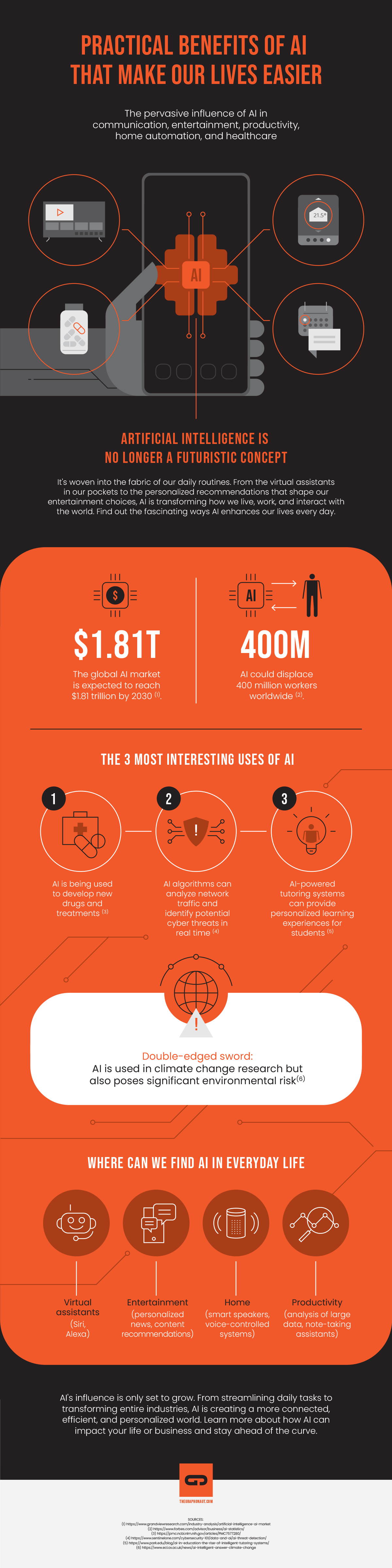
Infographic design by Boris Benko
Boosting Our Productivity
In our work lives, AI serves as an invisible assistant that helps us accomplish more with less effort. It summarizes long documents so we can quickly grasp key points, transcribes meetings so we can focus on the conversation instead of taking notes, and manages our calendars by suggesting optimal times for appointments.
Project management tools powered by AI can even help teams collaborate more effectively by predicting potential bottlenecks and suggesting solutions.
Creating Smarter Homes
Our homes are becoming increasingly intelligent thanks to AI. Smart speakers respond to voice commands to play music, answer questions, or control other devices. Thermostats learn our temperature preferences and adjust automatically to save energy.
Security systems use AI to distinguish between normal activity and potential threats, while smart appliances, like refrigerators and washing machines, optimize their operations based on our usage patterns.
Supporting Our Health and Well-Being
AI is revolutionizing how we monitor and manage our health. Wearable devices track our physical activity, sleep patterns, and vital signs, providing personalized insights and recommendations. Medication management systems help us stay on track with treatment plans.
Healthcare providers use AI-powered tools to assist with diagnoses and treatment decisions. Even our mental well-being benefits from AI through supportive chatbots that provide guidance and resources when we need them.(3)
These are just a few ways AI is transforming our lives today, but the technology is still young. As it matures, it has the potential to further enhance everything, from how we communicate to how we care for one another and beyond.
Sources:
- https://sendlayer.com/blog/how-ai-spam-filters-work-to-protect-your-inbox/
- https://www.datacenters.com/news/the-power-of-artificial-intelligence-in-game-development
- https://www.researchgate.net/publication/390177016_The_Role_of_AI_Chatbots_in_Mental_Health_Support_Improving_Accessibility_to_Counseling_and_Psychological_Care
FAQ
The key difference is that it learns the rules itself rather than following ones a human wrote. Older rule based systems required constant manual updates whenever spammers developed new techniques, making them reactive rather than proactive, and they could not recognize novel spam patterns they had never encountered before. Machine learning systems instead discover patterns in email data automatically, analyzing what distinguishes spam from legitimate messages and applying those discovered patterns to classify new emails with continuously improving accuracy. Modern filters go even further: some now use deep learning, where neural networks automatically learn complex patterns in email content and metadata, helping them spot even sophisticated spam and adversarial tricks like invisible characters or unusual symbols designed to fool machines.
Mostly through a technique called collaborative filtering, often combined with a second method that looks at the content itself. Collaborative filtering bases recommendations on user similarity, so if two viewers watch similar shows, the system recommends titles one person enjoyed to the other, while content based filtering instead focuses on the item’s own attributes, such as Spotify recommending songs with a similar tempo or vocal tone to ones a listener frequently plays. The stakes for getting this right are enormous: over 80% of the content watched on Netflix comes from its recommendations, and Netflix has stated that by lowering subscriber attrition, its recommendation algorithm saves the company roughly $1 billion a year.
Older non-player characters were built almost entirely on fixed instructions. No matter how detailed, NPC behavior traditionally remained predictable without AI, running on pre-scripted paths, limited dialogue, and canned reactions, like extras in a movie with one line to deliver that added atmosphere but lacked true agency. AI driven systems change what’s possible: Red Dead Redemption 2 employs a combination of neural network types to create realistic animal and NPC behavior that adapts to changing conditions in its open world, while in The Last of Us Part II, neural networks contribute to characters displaying emotional responses based on player actions, with decision making that reflects a level of adaptability and contextual awareness beyond scripted responses. That said, most games still blend both approaches. The real question isn’t whether an NPC is scripted or intelligent, but whether the system creates believable agency without damaging pacing, fairness, performance, or story control, since fully authored scripting is still how designers guarantee the rhythm of a stealth sequence or a specific emotional beat in a story.
The pipeline has several stages, and accuracy varies a lot depending on conditions and where in the process you look. Speech to text accuracy ranges from 97%+ on clean audio down to 65 to 88% in noisy meeting conditions, speaker identification adds an additional 11 to 13% error rate, and summarization can introduce hallucinated or omitted details, with errors compounding as a misheard word becomes a wrong attribution which becomes an incorrect action item. Despite these limitations, the productivity payoff appears real for most users: in Microsoft’s 2024 Work Trend Index Annual Report, 90% of surveyed users said AI helps them save time and 85% said it allows them to focus on their most important work. The practical takeaway is that these tools are genuinely useful for capturing the gist of a conversation, but action items and quoted commitments are worth a quick human double check before you rely on them.
It starts by watching what you do rather than what you tell it. During the first week, a learning thermostat primarily observes, making few automatic changes, then by week two it begins implementing a learned schedule while continuing to refine it, also factoring in outdoor temperature and sunrise or sunset times, so if you typically wake at 6am but it’s still dark in winter, it might delay heating startup until closer to your actual wake time to save energy. The Nest Learning Thermostat’s algorithm can detect patterns in as little as one week by tracking when you manually adjust the temperature and then automating those changes based on your demonstrated preferences, and studies show smart thermostats can reduce HVAC energy use by 10 to 15% as a result.
It depends heavily on what exactly is being measured. A comparative study found wearable devices had rather high measurement accuracy for heart rate, step count, distance, and sleep duration, but poor accuracy for energy consumption, or calories burned, which showed far more error across every device and activity type tested. Sleep tracking has a specific, well documented weak point: a meta-analysis of nearly 800 patients across 24 studies found wrist worn devices show systematic errors in total sleep time and consumer devices dramatically underestimate REM sleep by 50 to 70%, with error rates exceeding two hours per night in some cases, even though detecting simple sleep versus wake is fairly reliable. It’s also worth knowing that features like blood oxygen (SpO2) monitoring on consumer wearables are not FDA cleared for medical use and are classified only as wellness features, so they’re genuinely useful for spotting trends over time, just not a substitute for medical grade equipment.
The evidence is genuinely mixed, and this is an area where the research is still catching up to how widely these tools are already being used. On the access side, they clearly fill a gap: more than a third of psychologists report that their patients are turning to AI to act as an additional mental health resource, according to the American Psychological Association’s 2026 survey, though the APA has been clear that AI is not a safe or effective replacement for a qualified mental health provider. The clinical evidence base is thinner than the hype suggests: a systematic review of 160 studies on AI mental health chatbots found that only 47% actually focused on clinical efficacy testing, exposing a gap in robust validation of real therapeutic benefit. There are also documented risks for certain users: early data from a large psychiatric service system suggests that interaction with AI chatbots, especially if intense or of long duration, may contribute to the onset or worsening of delusions or mania in patients already prone to mental illness, with severe consequences in some cases. These tools can be a helpful supplement for everyday support, but they work best as one part of a broader picture that includes real professional care when it’s needed, not a replacement for it.
A note since this touches on mental health: if anything here feels personally relevant, it’s worth talking to a doctor or therapist, and I’m glad to help you think through finding the right support if that would help.
More than most people realize, partly because so much of it is invisible. Stanford’s AI Index 2026 found that generative AI reached 53% global population adoption within just three years of its mass market launch, and daily engagement is climbing fast too: 31% of US adults now interact with AI multiple times a day, up from 22% in early 2024. But direct chatbot use is only part of the picture: most people interact with AI without realizing it, through navigation apps rerouting around traffic, streaming services suggesting content, or banks flagging suspicious transactions, meaning when you include this indirect AI, the large majority of internet users are interacting with it dozens of times a day. So even people who’ve never opened a chatbot are almost certainly using AI systems constantly, just under the surface.