


AI used to feel like a “tech department thing.” You know, something happening in the background, somewhere between the data team and the engineers. Not anymore.
In 2025, AI is showing up in everyday work the way email did in the 90s: quietly at first, then suddenly everywhere. And the most interesting part? The skills that are in demand aren’t all about coding. A lot of them are surprisingly human: communication, judgment, clarity, and knowing how to get value out of tools like ChatGPT without creating chaos.
So if you’ve been thinking, “I’m not technical… is there even a place for me in this AI wave?” the answer is yes. But you’ll want the right skills, practical ones you can actually use.
Let’s walk through what the newest job and workforce data suggest, and then translate it into a skill plan you can start this month.
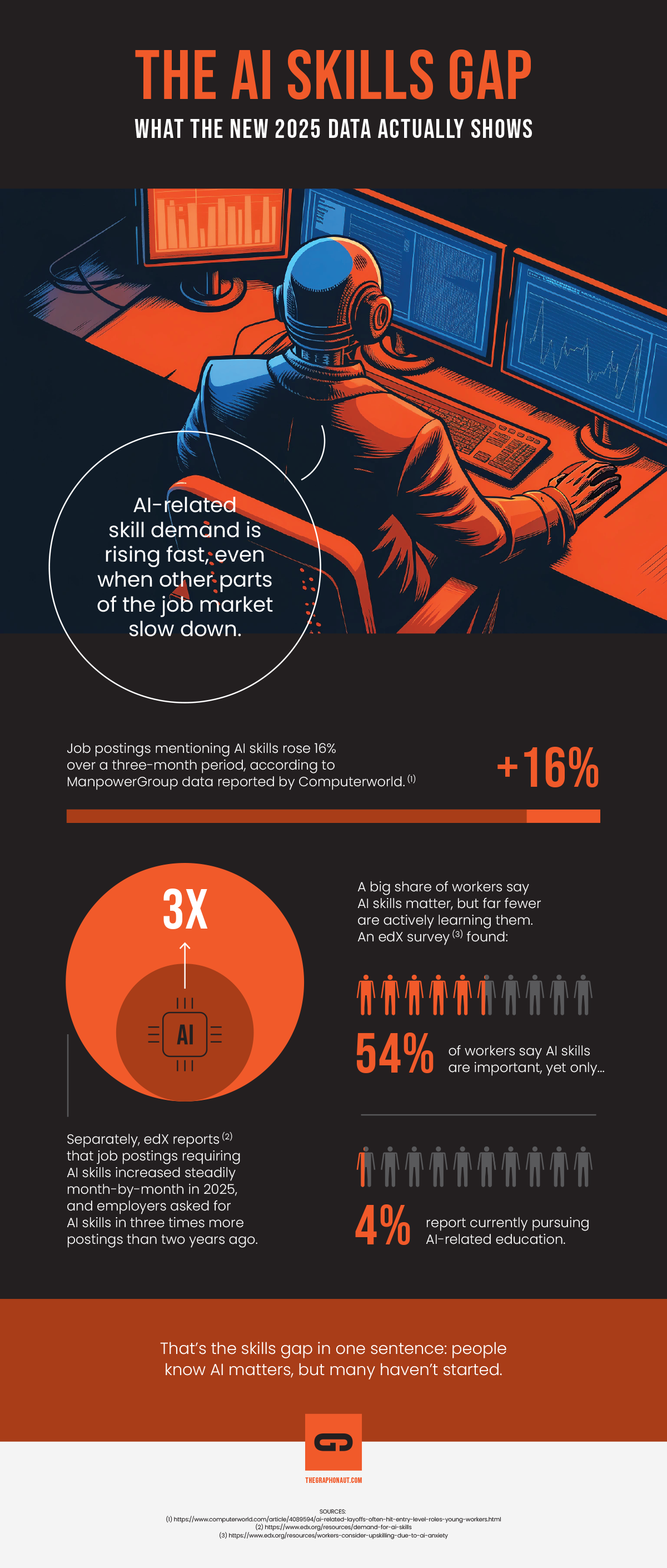
Infographic design by Boris Benko
And adoption? It’s climbing. A 2025 Gallup snapshot reported by Axios and Business Insider shows workplace AI use increasing, with chatbots as the most common tool among AI users.
So yes: “in-demand” is real. But it doesn’t mean “become a machine learning engineer by Friday.” It means something simpler:
People who can use AI well are becoming noticeably more valuable than people who use it badly, or not at all.
The most in-demand AI skills in 2026 (that regular people can learn)
1) AI literacy: The skill behind all other AI skills
If AI skills were a gym program, AI literacy is your warm-up and mobility work. It’s not flashy, but it prevents injury.
AI literacy means you can answer questions like:
- What is generative AI, and what is it not?
- Why do AI models “hallucinate”?
- What should I never paste into a chatbot?
- When should I trust AI—and when should I slow down and verify?
The World Economic Forum lists AI and big data among the fastest-growing skills, alongside broader “technology literacy.”
That’s basically the macro version of AI literacy: knowing how to operate in a world where AI is embedded into tools, platforms, and workflows.
Real-world example:
You ask ChatGPT to summarize a report. AI literacy is knowing how to say: “Give me the summary, but also list what you’re uncertain about and what should be verified.” That one habit turns AI from a confident liar into a useful assistant.
How to build it (without going back to school):
- Learn the basics of how LLMs work (in plain language)
- Practice verification habits (sources, cross-checking, “show your work” prompts)
- Understand privacy: what data is safe, what data is not
Mini-project: Create a one-page “AI use policy” for yourself: what you’ll use AI for, what you won’t, and how you verify outputs.

2) Prompt engineering: Talking to AI so it actually helps
Prompt engineering sounds technical. In practice, it’s closer to giving good instructions to a smart intern.
If you’ve ever said, “This AI tool is dumb,” there’s a decent chance the prompt was too vague. (And yes, sometimes the model genuinely messes up. AI isn’t magic.)
A strong prompt does four things:
- Sets a role (“Act as a recruiter,” “Act as a nutrition editor,” “Act as a customer support lead”)
- Gives context (audience, goal, constraints)
- Specifies format (bullet list, table, checklist, email draft)
- Adds quality control (ask for assumptions, risks, and verification)
Simple analogy:
A prompt is the steering wheel. AI is the engine. Without steering, you’ll still move—but not where you intended.
In-demand because: Job posting data from edX lists ChatGPT and prompt engineering among the top AI skills showing up in job postings.
Mini-project: Build a “prompt library” for your job:
- a prompt to summarize meeting notes
- a prompt to draft emails in your tone
- a prompt to generate 10 ideas, then rank them by feasibility
- a prompt to create a checklist for quality control
That becomes portfolio material.

3) Working with AI agents and copilots: Delegation, not just chat
If prompt engineering is “asking better questions,” AI agents are about “delegating multi-step tasks.”
Think of an AI agent as a chatbot plus a to-do list plus a tiny workflow engine: it can plan, execute steps, and (sometimes) use tools.
Now, do you need to build agents? Not necessarily. But knowing how to work with them is becoming a practical workplace advantage.
What this skill looks like in real life:
- You create a “research agent” workflow: gather sources, extract key points, flag disagreements
- You set a “content assistant” to generate outlines, FAQs, and headline variations
- You use a copilot inside tools you already use (docs, email, CRM)
The key skill: You’re still the editor-in-chief. The agent is the assistant.
Mini-project: Create an “agent brief” template:
- Goal
- Inputs (what you provide)
- Outputs (what you want back)
- Rules (tone, constraints, sources, do-not-do list)
- Verification steps

4) AI content creation and editing: text, image, video
Let’s be honest: AI content has a reputation problem. We’ve all seen that robotic, overly enthusiastic, vaguely incorrect “AI voice.”
The skill isn’t “generate content.” The skill is generate + edit + humanize + verify.
This is especially in demand because content is everywhere: marketing, internal comms, sales enablement, product pages, training materials. And most teams don’t have time.
Where people win with AI content in 2026:
- First drafts (blog outlines, email sequences, scripts)
- Repurposing (turn an article into LinkedIn posts, a newsletter, and a short video script)
- Localization (tone-adapted versions, not just translation)
- Visual generation for simple assets (illustrations, thumbnails, concept images)
But here’s the “grown-up” part:
You need a quality bar. Use checklists. Verify claims. Keep your voice.
5) AI-powered research and verification: Finding truth in a noisy Internet
This is one of the most underrated skills. And it’s becoming more valuable as AI-generated content floods the web.
AI can help you research faster, but it can also confidently invent nonsense. AI literacy plus verification turns research into a superpower.
In-demand behavior in 2026:
- Asking for sources
- Checking sources (and rejecting weak ones)
- Cross-referencing claims
- Not confusing “sounds right” with “is right”
If you want to be useful in almost any modern role, become the person who can say: “Here’s what the data suggests, and here’s how confident we should be.”

6) Data analysis with AI: Spreadsheets, dashboards, better decisions
You don’t need to be a data scientist to benefit from AI-assisted data analysis.
In many workplaces, the real bottleneck is still:
- messy data
- unclear questions
- weak interpretation
AI helps with:
- cleaning data (spotting duplicates, formatting errors)
- summarizing trends
- generating draft insights
- explaining charts in plain language
WEF’s skills outlook includes AI and big data, which signals growing importance for data-adjacent fluency even outside technical roles.
What this looks like for non-technical people:
- “Explain what changed month-over-month and why it might matter.”
- “Find anomalies in this dataset and propose possible causes.”
- “Turn this table into a management summary with three recommendations.”
7) No-code automation: Making AI save you time every week
This is where AI stops being “cool” and starts being useful.
No-code automation is connecting tools so that work happens with less manual effort:
- form submission → draft email response
- meeting notes → action items → tasks created
- customer review → sentiment tag → alert to team
- new lead → enrichment → CRM update
And this trend is not small. Gartner famously projected that 70% of new applications would use low-code/no-code technologies by 2025, up from under 25% in 2020.
That’s basically a signal flare: organizations want faster building, faster iteration, more “citizen development.”
Mini-project: Automate one annoying weekly task. Just one. Track the minutes saved. After a month, you’ve got a measurable win.
8) Responsible AI: Ethics, privacy, security, and “Don’t get fired” basics
This skill is boring right up until it saves you.
Responsible AI includes:
- Privacy (what data you can and can’t share with tools)
- Security (sensitive info, credentials, internal docs)
- Bias and fairness (algorithmic bias in hiring, lending, moderation)
- Transparency (when you used AI, how outputs were verified)
- Human oversight (who is accountable)
In many workplaces, the person who can create a simple, practical AI usage guideline becomes instantly valuable—because leaders want AI productivity without risk.
9) Human skills that become more valuable because of AI
Here’s a twist people miss: as AI handles more routine work, human judgment becomes more visible.
WEF highlights creative thinking, curiosity and lifelong learning, and resilience as rising skills alongside tech skills.
In practice, the “human stack” that pairs best with AI is:
- critical thinking (spot errors, challenge assumptions)
- problem-solving (turn outputs into actions)
- communication (clarify goals, align stakeholders)
- creativity (new angles, better metaphors, better messaging)
AI can generate 20 ideas. You still need to pick the right one.
Which AI skill should you learn first? A simple matchmaker
If you’re unsure where to start, pick the skill that maps to your daily work:
- Office / admin / operations: AI literacy → automation → data summaries
- Marketing / content: prompt engineering → content creation → verification workflows
- Sales / customer success: copilots/agents → email + call summaries → CRM automation
- HR / recruiting: responsible AI → AI-assisted screening guidelines → structured prompts
- Managers: AI literacy → decision-making with AI → governance and training

A realistic 30-day upskilling plan (No Burnout)
Week 1: AI literacy basics
- Learn how LLMs fail (hallucinations, bias, outdated info)
- Create your personal AI safety checklist
Week 2: Prompting that produces usable work
- Build 10 prompts you’ll actually reuse
- Start a prompt library
Week 3: One automation
- Automate one workflow end-to-end (even a simple one)
- Measure time saved
Week 4: A portfolio mini-project
- Create a one-page case study:
- problem → AI-assisted workflow → outcome → what you verified
This is what makes your skill “real” to employers.
- problem → AI-assisted workflow → outcome → what you verified
Sources:
- https://www.computerworld.com/article/4089594/ai-related-layoffs-often-hit-entry-level-roles-young-workers.html
- https://www.edx.org/resources/demand-for-ai-skills
- https://www.edx.org/resources/workers-consider-upskilling-due-to-ai-anxiety
- https://www.axios.com/2025/12/15/ai-chatgpt-jobs
- https://www.weforum.org/publications/the-future-of-jobs-report-2025/digest/
- https://www.gartner.com/en/newsroom/press-releases/2021-11-10-gartner-says-cloud-will-be-the-centerpiece-of-new-digital-experiences