
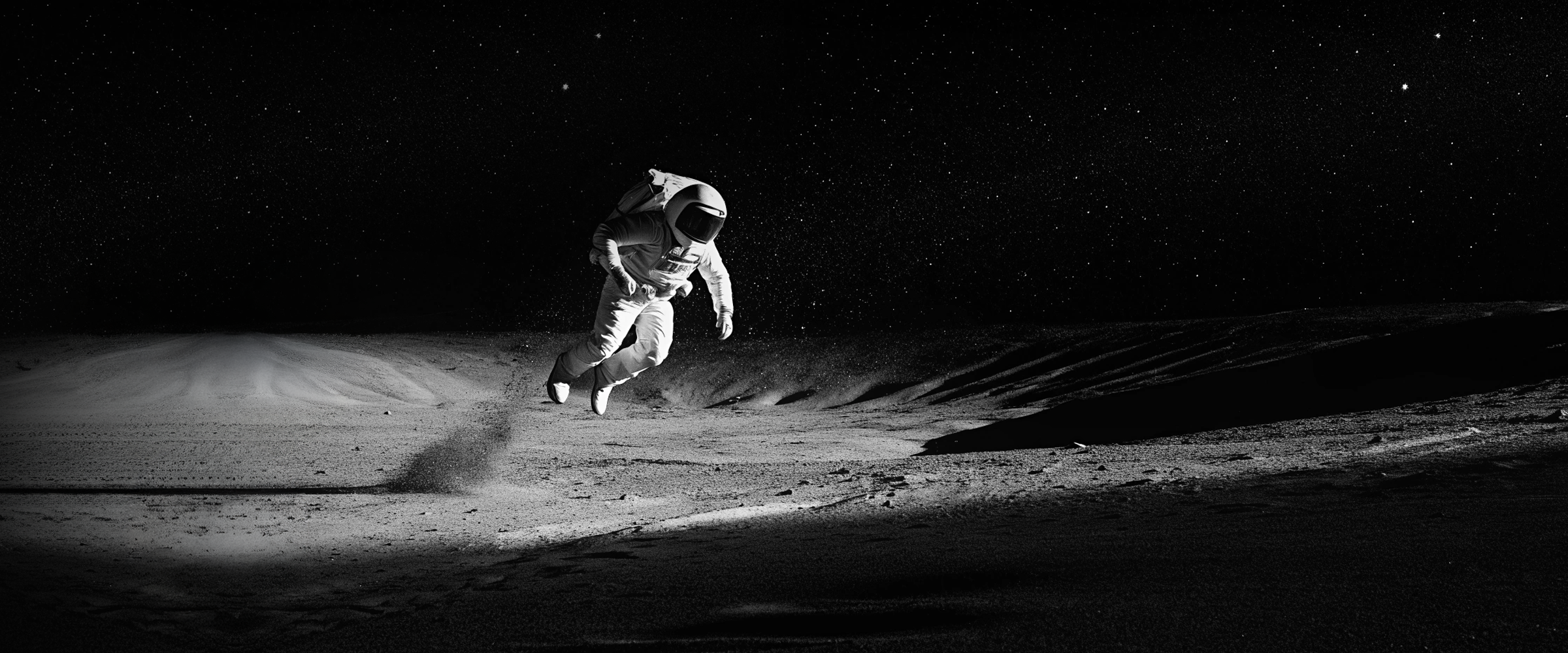

On the Moon, you’d weigh only 1/6th of your Earth weight—here’s why.

A lighter step in space
Imagine stepping on the scale and instantly weighing over 80% less—without any dieting or exercise. That’s exactly what happens under Moon gravity.
The science behind Moon gravity
This difference comes down to size and mass. The Moon is much smaller than Earth, so its gravitational pull is weaker. If you weigh 100 kilograms here, you’d register just 16.5 kilograms on the Moon. For someone at 180 pounds on Earth, that’s a mere 30 pounds—lighter than a medium-sized dog.

More bounce to the ounce
This weaker pull is why NASA astronauts in Moon landing footage look like they’re hopping in slow motion. Every step launches them higher and farther than possible on Earth. Picture carrying heavy groceries on Earth—now imagine they weigh about as much as a small backpack. That’s the Moon effect. So, if you ever take a trip to space, be prepared to leap higher, carry more, and feel lighter than ever before.
FAQ
Multiply your Earth weight by 0.165, or divide it by six for a quick estimate. If your mass is 80 kg, the Moon pulls on you with about 130 newtons of force. A bathroom scale calibrated for Earth would show about 13.2 kg because it uses Earth’s gravity to convert that force into a reading.
You stand much closer to the Moon’s center. The Moon’s radius is about 27% of Earth’s, and surface gravity depends on mass divided by the square of the radius. The shorter distance is why the Moon’s surface gravity is about 16.5% of Earth’s despite its much smaller mass.
Yes, if you left the ground at the same upward speed. A jump that takes you 30 cm above your starting point on Earth would take you about 1.8 m above it on the Moon. In practice, equipment affects how you move. Apollo 11 astronauts reported that their life-support backpacks tended to tip them backward.
A heavy case would be easier to lift because the Moon pulls on it less strongly. Its mass still determines how much it resists changes in motion. If the case were sliding at the same speed on Earth and on the Moon, stopping it in one second would take the same net force in either place.
It varies slightly from place to place. Dense material beneath some impact basins creates areas of stronger gravity. NASA’s GRAIL mission mapped these differences by measuring tiny changes in the distance between two spacecraft orbiting the Moon.
Source: Earthhow