



Holiday gift-giving is a tradition cherished around the world. But as much as we love giving and receiving, it sometimes feels as though the custom has lost its original meaning. Instead of a simple act of kindness and connection, gift-giving has increasingly become an end in itself.
In the U.S., the holiday shopping season starts surprisingly early — as early as September. By November, most Americans have already bought their gifts, while only one in five waits until December.
Once-packed shopping malls are now largely replaced by online shopping, with over 70% of shoppers choosing gifts via e-commerce sites and apps.
The average American buys gifts for eight people: 63% for parents, 53% for children, 51% for siblings, 24% for friends, 23% for colleagues, and 8% even for clients.
Infographic design by Boris Benko
There is a bright side. About 76% of consumers prefer to buy Christmas gifts from companies committed to sustainability, social responsibility, and ethical practices. Among millennials, that number rises to 86%. Two-thirds of shoppers (66%) are even willing to pay more for sustainable products.
Yet holiday giving has a darker side. Unwanted gifts worth $8.3 billion are thrown away each year. Thankfully, more people are thinking responsibly — 21% plan to re-gift presents they don’t like. Perhaps this small shift in perspective holds the key to rediscovering the true spirit of giving.
Conclusion:
Consumers are increasingly choosing gifts with meaning and purpose — proving that thoughtful giving has become the new mark of taste and awareness.
FAQ
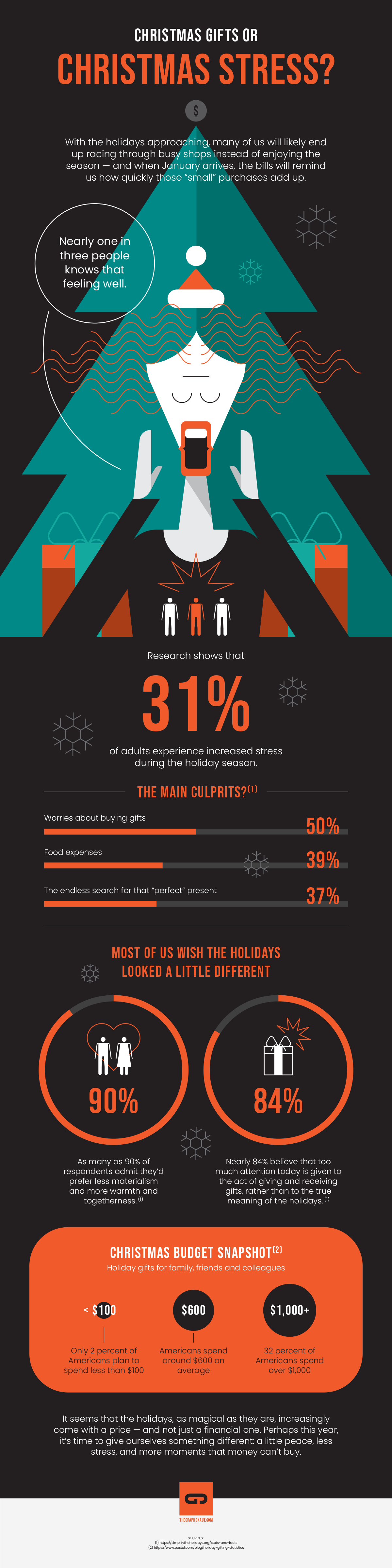
In a U.S. poll published in December 2022, 31% of adults expected the holidays to be more stressful than the previous year. Paying for gifts was a concern for 50% of respondents, and 37% worried about finding gifts. The poll captured what people anticipated before the holidays.
Price was a poor predictor of how much recipients appreciated a gift in three studies by Francis Flynn and Gabrielle Adams. Givers tended to expect the price to matter more than it did. A small gift can feel personal when it shows you’ve noticed what someone enjoys or needs.
Agree on a spending limit before anyone starts shopping, then have each adult draw one name. If eight adults each buy for the other seven, that’s 56 gifts. With a name draw, the group exchanges eight gifts and everyone still gives and receives one.
Finder estimated how much Americans would spend on unwanted holiday gifts in 2022. It used survey responses from 2,112 U.S. adults to estimate how many people would receive unwanted presents and what those gifts were worth. Respondents reported keeping, exchanging, and regifting unwanted items.
Think about what it will take for the recipient to use it after Christmas. In gift-giving studies, recipients put more weight on practical details than givers expected. For a restaurant voucher, that could mean choosing a place nearby and checking that the voucher gives them enough time to book.