


Reading strengthens the brain, improves literacy, develops empathy, and enriches vocabulary. It also reduces stress, improves sleep quality, and has a positive effect on mental health. Yet statistics reveal some fascinating differences – from modest European reading habits to a genuine American passion for books.
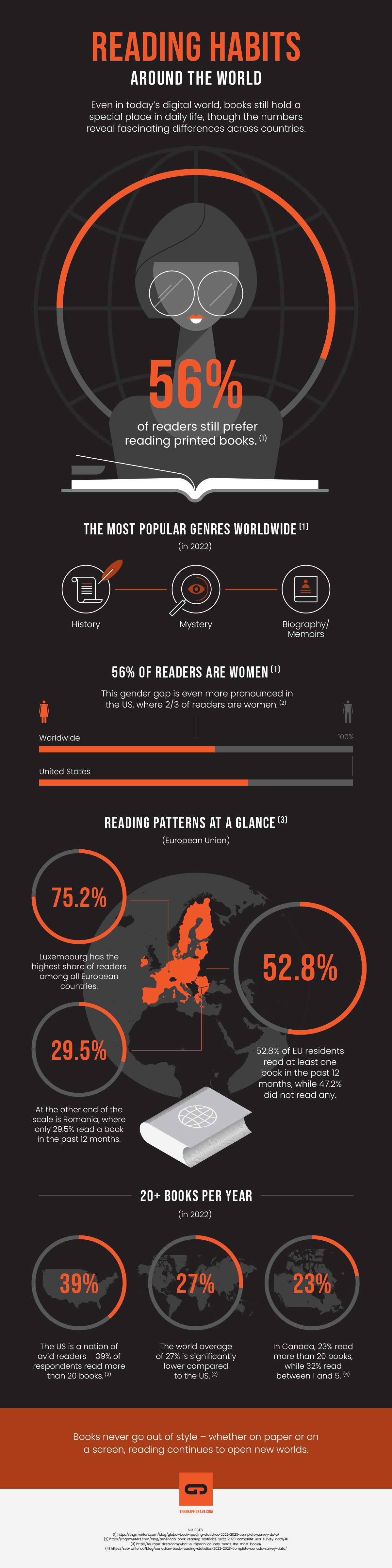
According to EUROSTAT data, almost half of Europeans do not read a single book each year, and in Romania, Cyprus, and Italy, around 70% of people do not have the habit of reading. In contrast, Luxembourg, Denmark, and Estonia lead in readership – in these countries, fewer than 30% of people go an entire year without reading a book.
Infographic design by Boris Benko
On a global scale, only 4% of individuals fall into the category of non-readers, while 27% read more than 20 books per year. When it comes to dedication to reading, American and British readers take the lead – as many as 39% and 44%, respectively, have read more than 20 books in a year.
Reading offers countless benefits, but for it to become a lifelong habit, it needs to start earl
– and it must be fun and accessible. Be a role model for your children: read together, talk
about what you’ve read, visit libraries, and let them choose what they want to explore
among the pages.
Concusion:
Although reading habits vary across the world, the benefits of books remain undeniable. It is worth investing in this habit and encouraging new generations to discover the joy and magic of reading.
FAQ
There is, and it comes from one of the most widely cited studies on the subject. A 2009 study conducted by Mindlab International at the University of Sussex found that reading for as few as six minutes reduced stress by as much as 68%, outperforming listening to music at 61%, drinking tea or coffee at 54%, and going for a walk at 42%. The physiological effect was measurable rather than just self-reported: participants who read for six minutes, whether a newspaper or a book, showed a slowed heart rate and reduced muscle tension, with the study’s cognitive neuropsychologist noting that it doesn’t matter much what you read, since the key is losing yourself in something engrossing.
The mechanism researchers point to is called theory of mind, the ability to recognize that other people hold beliefs and feelings different from your own. A widely cited 2013 study in Science by Kidd and Castano provided experimental evidence that reading passages of literary fiction, compared to nonfiction or popular fiction, enhanced readers’ performance on theory of mind tasks. The type of reading appears to matter more than the amount: a seminal study by Mar and colleagues found that reading fiction, but not nonfiction, was positively associated with a greater tendency to transpose oneself into the feelings of fictional characters and with better performance at inferring others’ mental states from their eyes. One important nuance: behavioral work found that fiction reading over a one-week period increased empathy only when readers reported a high level of “transportation,” meaning genuine absorption into the characters’ mental lives, suggesting the effect depends on how deeply you engage rather than simply on how many pages you turn.
There’s at least one striking study on longevity, though it needs careful reading. Yale researchers following 3,635 adults over 50 for up to 12 years found that book readers had a 20% reduction in risk of mortality compared to non-book readers after adjusting for age, sex, race, education, comorbidities, self-rated health, wealth, marital status, and depression, with cognition partly mediating the effect. The frequently quoted “nearly two extra years” figure deserves a caveat, though. The 23-month survival advantage came from unadjusted survival curves, and once the full set of measured differences between readers and non-readers was accounted for, the adjusted gap at that same point was four months rather than 23. Notably, book reading showed a significantly stronger association with survival than reading newspapers or magazines, which is what makes the finding distinctive.
For children, the gap is enormous and starts before school does. A study analyzing 60 commonly read children’s books estimated that parents who read one picture book with their children daily expose them to roughly 78,000 words per year, and cumulatively, children from literacy-rich homes hear about 1.4 million more words through storybook reading over the five years before kindergarten than children who are never read to. Part of what makes book vocabulary uniquely valuable is that it isn’t the vocabulary of everyday speech: children’s book reading sessions are more lexically diverse than standard caregiver-child conversations, yet nationally representative data suggest around 25% of caregivers never read with their children. Among older children, the difference in reading volume compounds dramatically: researchers have estimated that avid readers encounter as many as 1.8 million words per year, while reluctant readers read only about 8,000 words for their own enjoyment.
For comprehension, the research consistently favors paper, at least for certain kinds of reading. Four separate meta-analyses have shown inferiority in reading comprehension for digital media compared to print, a phenomenon researchers call the screen inferiority effect, thought to result from screens triggering more superficial strategies like skimming and scanning rather than the deeper processing associated with printed books. The effect isn’t uniform, though, and that’s the useful part: the screen inferiority effect is strongest with informational or expository texts, reading under time pressure, longer texts, and when deep retention matters, while for casual reading and skimming the difference is smaller. There’s also a genuine counterpoint worth knowing: a meta-analysis of 32 studies covering 2,239 participants focused specifically on narrative texts found no significant impact of reading medium on comprehension of a story, and no difference across computers, e-readers, or tablets. So for reading a novel for pleasure, the format may matter far less than for studying a textbook.
This is where format genuinely does matter. In a study using polysomnography, researchers had participants read for 90 minutes before bed either on a smartphone with a blue-light filter, without one, or from a printed book, and found significant melatonin attenuation immediately after smartphone reading without the filter, with adults still showing significantly reduced melatonin at bedtime and a measurable reduction in deep N3 sleep during the first quarter of the night. Interestingly, adolescents in the same study fully recovered from the melatonin suppression within 50 minutes before bedtime, while adults did not, suggesting age changes how quickly the body bounces back. It’s worth noting the field is being reexamined: a Canadian study of more than 1,000 adults published in Sleep Health found overall sleep health was similar between people who used screens every night and those who never did, with researchers arguing earlier studies used experimental conditions that don’t reflect ordinary daily use.
The EUROSTAT figures the article cites correlate closely with a set of structural factors rather than any inherent national temperament. Countries at the top of European readership rankings tend to share high public library density and funding, strong reading instruction embedded in school systems, high adult literacy rates, and relatively high disposable income for discretionary purchases like books. The Nordic and Baltic countries in particular have long-standing public investment in library networks and translation programs, which keeps a wide range of books physically and financially accessible. Southern and Eastern European countries in the lower tier generally have thinner library infrastructure per capita and higher relative book prices compared to income, meaning a book represents a larger share of a household budget. The pattern is less about culture and more about how easy a country makes it to encounter a book without deliberately seeking one out.
Both, and understanding why is genuinely instructive about reading statistics. The two figures measure different things and come from very different sources. The EUROSTAT-based European figure counts people who read zero books in a full year, drawn from official statistical agency surveys designed to be nationally representative. The 4% global figure comes from an online survey of self-selecting participants and appears to use a broader definition of “reader” that includes any reading material, not strictly books. Online surveys about reading habits have an obvious sampling problem: people who volunteer for a reading survey on the internet are disproportionately likely to be readers, so non-readers are systematically underrepresented. When you see reading statistics that seem to conflict this dramatically, the usual explanation is a difference in what counts as reading and how the sample was gathered, rather than a genuine contradiction in the underlying reality.
Sources:
- https://europe-data.com/what-european-country-reads-the-most-books/
- https://thgmwriters.com/blog/american-book-reading-statistics-2022-2023-complete-usa-survey-data/#1
- https://seo-writer.ca/blog/canadian-book-reading-statistics-2022-2023-complete-canada-survey-data/
- https://thgmwriters.com/blog/global-book-reading-statistics-2022-2023-complete-survey-data/