

Every product we buy, from smartphones to jeans, carries a hidden water footprint measured in millions of liters.
This is why the water footprint is increasingly discussed — a measure of the “hidden” water in products. It has three types: blue (surface and groundwater), green (rainwater), and grey, which reflects the water needed to dilute pollution and maintain water quality.
The global outlook is far from optimistic. In 2019 alone, our worldwide water demand reached 4,600 trillion liters. That is a difficult scale to mentally process. But it is only climbing. for 2050 warn that we will consume anywhere from 5,500 to 6,000 trillion liters. More than half of the blue water footprint already disrupts natural ecological flows, while as much as 80% of industrial and municipal wastewater worldwide is discharged without adequate treatment. Paradoxically, water is everywhere around us — yet clean and accessible water is becoming increasingly scarce.
Reducing Consumption Saves Water
The solutions are often simple: the rule of the Three Rs — Reduce, Reuse, Recycle — remains the most powerful tool for individuals. Buying less means less production and lower water consumption, while recycling and choosing second-hand or reusable products further reduce one’s personal water footprint.
Companies also play an important role — calculating their water footprint and managing water more intelligently through recycling and reduced consumption are essential for long-term business sustainability.
Check the infographic and find out how much water is hidden in the everyday products you use.
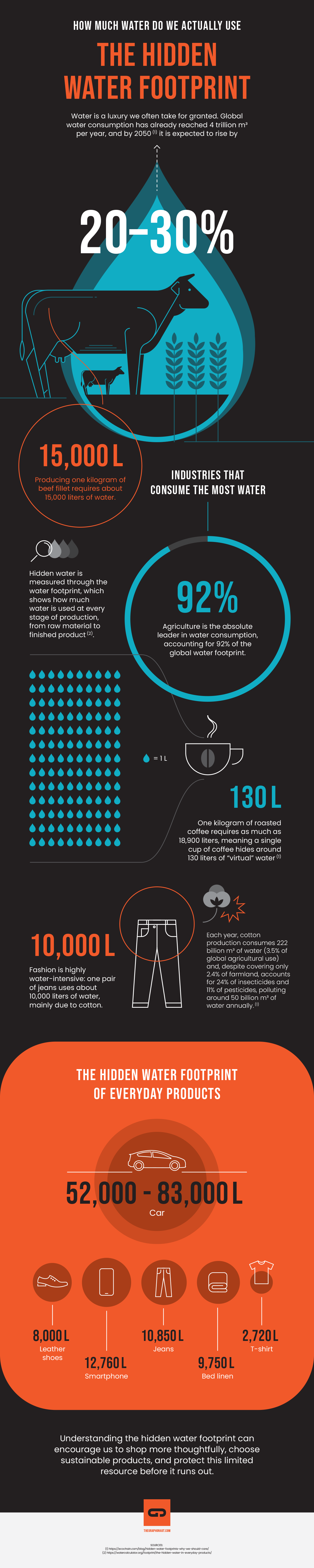
Infographic design by Boris Benko
Small choices, big water impact
A “zero” water footprint does not exist, but small everyday decisions can have a significant impact. Sustainable production and mindful consumption help preserve a resource without which there is no future.