

AI doesn’t invent bias. It inherits it. And in a field where women hold just 22% of roles, the question isn’t whether the problem exists — it’s how deep it goes.
Artificial intelligence has become one of the most consequential tools in modern life — shaping how we are hired, diagnosed, assessed, and served. The promise is objectivity: decisions made by data, not by the prejudices of any individual. But that promise carries a flaw. AI systems don’t generate their own understanding of the world. They learn from ours. And ours is far from neutral.
Consider what this looks like in practice.
A woman goes to her doctor with symptoms she’s been managing for weeks. An AI diagnostic system processes the available data and returns a result — precise, evidence-based, apparently objective. Exactly what modern medicine promises. What it doesn’t surface is where that evidence came from.
The data has a history.
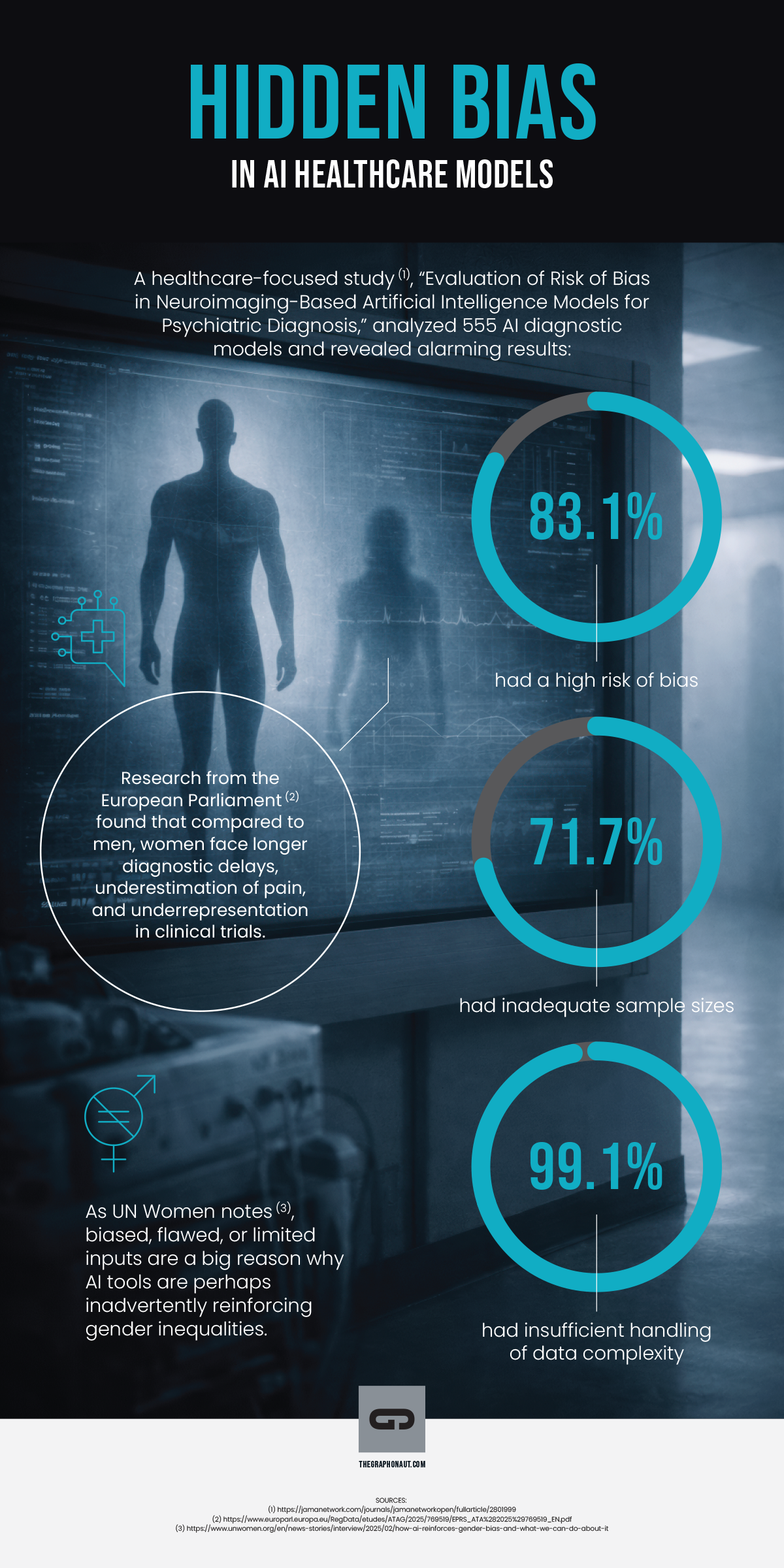
For decades, women have been underrepresented in clinical trials. Their pain has been systematically underestimated. The research base that medicine relies on was built largely around male subjects. When AI diagnostic tools train on that same data, they don’t correct for those gaps — they replicate them. Research already shows that women face longer diagnostic delays and spend more of their lives in poor health relative to men.
The numbers behind this are hard to dismiss. A 2023 analysis of 555 AI diagnostic models found that 83.1% carried a high risk of bias. Most also struggled with inadequate sample sizes and insufficient handling of data complexity. These aren’t fringe tools — they’re the systems informing real clinical decisions.
Infographic design by Boris Benko
The data problem, though, is only half the picture.
AI doesn’t generate bias independently — it amplifies what’s already embedded in the information it’s trained on. Which raises a harder question: who decides what goes in? In the global AI workforce, women hold just 22% of roles and only 14% of senior leadership positions. The people most affected by gender bias in AI are the least represented among those building it.
Biased inputs, a workforce that skews heavily male, and outputs that shape real decisions about people’s health, careers, and finances. Healthcare is just one example. The same equation plays out in hiring algorithms, financial tools, legal systems, and beyond — in ways most people never see, because the results look exactly like objectivity.
Discover the full story — the real-world consequences, the data behind them, and the initiatives working to close the gap — in Graphonaut Magazine Issue 02, available now in the Graphonaut Store.