

Why the Moon Turns Red: Discovering Lunar Eclipses
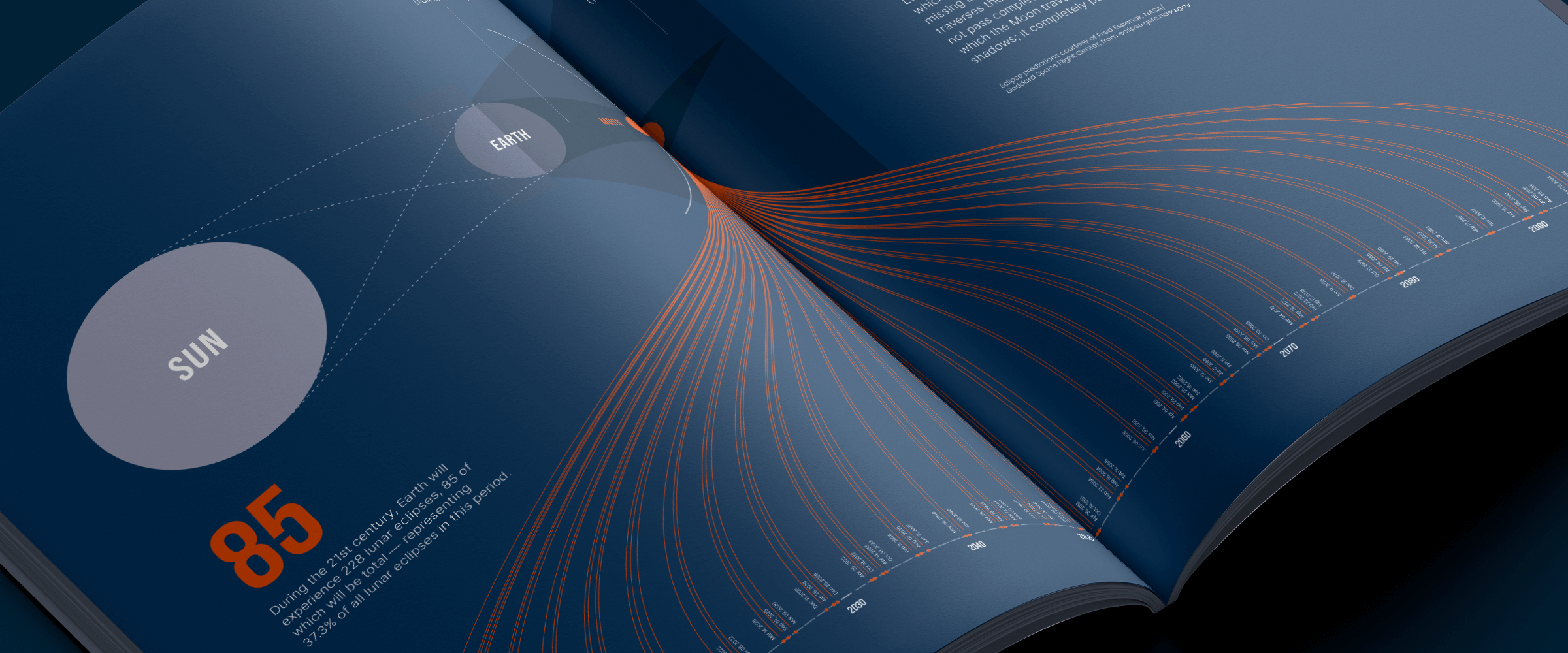
Discover the full visual story of Total Lunar Eclipses in the first issue of Graphonaut Magazine—featuring all 85 total lunar eclipses of the 21st century. Subscribe to our newsletter to get your free digital PDF copy delivered straight to your inbox.
You’ve probably heard of a solar eclipse — that dramatic event when the Moon moves in front of the Sun, blocking its light and briefly turning day into night. But a lunar eclipse can be just as spectacular.
Unlike the Sun, the Moon doesn’t produce its own light; it reflects sunlight. A total lunar eclipse occurs when the Earth moves between the Sun and the Moon, casting its shadow across the Moon’s surface. During this alignment, the Sun, Earth, and Moon line up perfectly, similar to how the Earth passes through the Moon’s shadow during a solar eclipse. At the height of the eclipse, the Moon often takes on a reddish color.
Lunar eclipses, unlike solar eclipses, pose no risk to your eyes and can be safely viewed without any special protection. During a lunar eclipse, the Moon simply reflects sunlight and appears no brighter than a regular full Moon — something you’ve probably watched many times without concern.

Available in the Graphonaut Store.
The “Blood Moon” Effect
Even though the Earth blocks direct sunlight from reaching the Moon, it still glows because some sunlight is bent through the Earth’s atmosphere. Shorter wavelengths like blue and violet scatter, while longer wavelengths — red and orange — pass through and reach the Moon, giving it a reddish glow. This is why a total lunar eclipse is often called a Blood Moon. Depending on atmospheric conditions, the Moon’s color can range from orange to deep red or even brown.
Types of Lunar Eclipses
Lunar eclipses can only occur during a full Moon, when the Moon may pass through either the Earth’s penumbra (partial shadow) or umbra (full shadow).
There are three main types of lunar eclipses. A penumbral eclipse occurs when the Moon passes through the Earth’s penumbra, resulting in a subtle dimming that is often difficult to notice. A partial eclipse happens when part of the Moon moves into the Earth’s umbra, causing part of its surface to darken. Finally, a total eclipse takes place when the entire Moon passes through the Earth’s umbra.

Infographic design by Boris Benko
Extreme Lunar Eclipses
According NASA Lunar Eclipse Catalog, the longest Total Eclipse occurred on July 27, 2018, and lasted 1 hour, 42 minutes, and 57 seconds. The shortest Total Eclipse took place on April 4, 2015, and lasted just 4 minutes and 43 seconds. The smallest Total Eclipse also occurred on April 4, 2015, with an umbral magnitude of 1.0008. Largest Eclipse by Umbral Magnitude is expected on June 26, 2029, with an umbral magnitude of 1.8436.
How Common Are Total Lunar Eclipses?
In the 21st century (2001–2100), there will be 228 lunar eclipses, of which 85 (around 37%) will be total eclipses, As stated by NASA.
Overall, about 29% of all lunar eclipses are total. From any specific location on Earth, a total lunar eclipse is visible roughly every 2.5 years. Since nearly everyone on the night side of the planet can witness a lunar eclipse, they are far more commonly seen than total solar eclipses.
FAQ
Because the Moon’s orbit is tilted relative to Earth’s path around the Sun. Anywhere from four to seven times a year, Earth, the Moon, and the Sun line up just right to create an eclipse, and the tilt of the Moon’s orbit around Earth relative to Earth’s orbit around the Sun is the reason we have occasional eclipses instead of eclipses every month. More precisely, the Moon’s orbital plane is inclined about 5 degrees relative to Earth’s orbital plane, and eclipses can only occur when the Moon is near one of two points called lunar nodes, where its orbit crosses the ecliptic, during a full or new moon. Most months, the full Moon simply passes above or below Earth’s shadow rather than through it.
This comes down to something astronomers call an “eclipse season.” The Moon’s nodes slowly regress around Earth, completing a full cycle in about 18.6 years, but they line up with the Sun roughly every 173.3 days, or about 5.8 months. Each of these periods lasts a few weeks and allows one or two lunar eclipses, and typically one solar eclipse, to occur. A recent example makes this concrete: an annular solar eclipse on February 17, 2026, was followed exactly two weeks later by the total lunar eclipse of March 2 to 3, 2026, both part of the same eclipse season. Eclipses separated by a longer, more precise interval also repeat in a pattern astronomers call a Saros cycle. Similar solar and lunar eclipses repeat every 6,585.3 days, a bit more than 18 years, with the Sun, Moon, and Earth returning to nearly the same relative positions each time.
The color and brightness depend on exactly what is happening in Earth’s atmosphere at that moment, not on anything about the Moon itself. Volcanic eruptions are one of the most significant factors: eruptions that spew large amounts of ash into the air are generally followed by several years of unusually dark, deep red eclipses, and the 1991 eruption of Mount Pinatubo made the eclipse of December 9, 1992 so dark that many observers rated it a 0 on the five point brightness scale. That scale, devised by French astronomer André Danjon in 1921, runs from L=0 for a very dark eclipse where the Moon is almost invisible, up to L=4 for a very bright copper-red or orange eclipse with a distinctly bluish, bright shadow rim. So two total eclipses can look completely different depending on how much dust and cloud happen to be sitting in Earth’s atmosphere that night.
Because they genuinely are, and the reason is geometry rather than frequency. On average it takes about 375 years for a total solar eclipse to happen again at the exact same location, while a total lunar eclipse can be seen from any given spot roughly every 2.5 years. The difference exists because a solar eclipse is only visible from a very narrow path on Earth’s surface, whereas a lunar eclipse is visible from every location on the night side of the planet for as long as it lasts. In other words, you have to travel to a total solar eclipse, but a total lunar eclipse essentially travels to you, as long as it’s nighttime where you are.
They have, in some fairly consequential ways. Aristotle observed that Earth’s shadow always had a circular shape as it moved across the Moon during an eclipse, and reasoned that only a sphere could cast that kind of shadow, which became one of the earliest pieces of evidence that Earth was round. Centuries later, the phenomenon played a role in one of history’s more famous survival stories. According to an account by his son Ferdinand, Christopher Columbus, stranded in Jamaica in 1504, consulted an almanac and correctly predicted an upcoming total lunar eclipse. He warned the local Indigenous population that his gods were angry and would turn the Moon a bloody red color as a sign of their displeasure. When the eclipse arrived exactly on schedule, the account claims the Jamaicans agreed to resume supplying Columbus and his crew with food, though many historians remain skeptical of the story’s details.
It comes down to two things: how centrally the Moon passes through Earth’s shadow, and how close the Moon is to Earth at the time. The eclipses with the largest magnitude and longest totality all occur when the Moon passes almost perfectly through the center of the umbral shadow, and when the Moon is near perigee, its closest point to Earth, which is when the ratio of the Moon’s size to the umbra’s size is at its maximum. When both factors align, the Moon takes the longest possible path through the widest part of the shadow, stretching totality out toward the nearly 103 minute maximum. When the Moon instead grazes the shadow’s edge, or is farther from Earth and appears smaller relative to the umbra, totality can be as brief as a few minutes.
It’s simply two separate lunar phenomena happening to coincide, not a distinct type of eclipse. A Super Blood Moon combines a supermoon and a total lunar eclipse, resulting in a Moon that appears both larger and redder than a typical eclipse. In the 21st century, of the 87 total lunar eclipses that occur, 28 coincide with a supermoon and 6 coincide with a micromoon, the opposite phenomenon where the Moon is near its farthest point from Earth. A blood moon refers specifically to a total lunar eclipse, defined by Earth’s shadow, while a supermoon refers to a full moon at the Moon’s closest approach to Earth, defined purely by orbital position. They are genuinely different events that simply overlap on occasion.