

Do you use caffeine to help you wake up and stay focused? You’re not alone. Each day, millions of people consume caffeine to enhance their alertness and concentration.
Coffee stands out as one of the most popular beverages globally, enjoyed by people of all ages. (1) According to statistical data, 81% of Baby Boomers worldwide prefer brewing coffee at home, while 14% of Generation Z favor takeout coffee as their go-to option. (2)
This versatile beverage can be prepared using a variety of coffee beans and comes in many styles, including espresso, cappuccino, and americano. While many drink coffee for its energizing effects, it’s also linked to several potential health benefits. For example, research suggests coffee may lower the risk of liver cancer, offer protection against Parkinson’s disease, and support heart health. (1)
A Look at the Global Coffee Industry
Coffee originated in Ethiopia, where it is still widely grown today. Currently, South America dominates the global coffee scene, producing nearly half of the world’s supply. In the 2023/24 season, the region harvested approximately 89 million 60-kilogram bags of coffee. (3)
The United States led the global coffee market in revenue, generating around $85 billion. Brazil followed closely behind, earning about $31 billion. In terms of exports, Brazil, Switzerland, and Germany were the top three exporters in 2023. (3)
Coffee farmers primarily cultivate two main types of beans: Arabica and Robusta. Arabica is the more expensive variety, with prices recorded at $2.93 per kilogram in 2018 and projected to reach $7.25 by 2026. Robusta was priced at $1.87 per kilogram in 2018 and is expected to rise to $5 by 2026. (4)
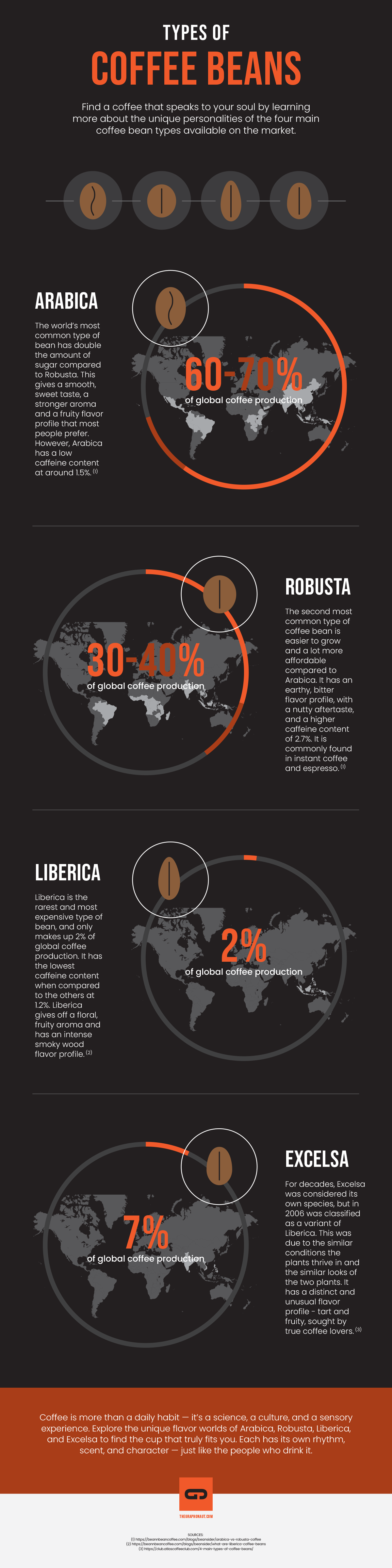
Infographic design by Boris Benko
How Much Coffee Is Too Much?
According to the Mayo Clinic, up to 400 milligrams of caffeine per day is generally safe for most healthy adults—roughly the equivalent of four cups of brewed coffee. However, caffeine is not recommended for children, and teenagers and young adults should be cautious, particularly when combining it with alcohol or other substances. (5)
Pregnant or breastfeeding individuals, as well as those trying to conceive, are advised to consult their healthcare provider to keep caffeine intake below 200 milligrams daily. (5)
Even for adults, excessive caffeine can cause unwanted side effects. If you regularly consume more than four cups of coffee a day and experience symptoms such as headaches, insomnia, anxiety, irritability, rapid heartbeat, frequent urination, or muscle twitching, it may be time to scale back. (5)
But when consumed in moderation, coffee is a delightful, magical drink that’s captivated many around the world. Whether you like to drink it as part of your morning routine or pour it over some ice cream as a dessert after dinner, coffee is a versatile treat that can be enjoyed any time of day.
FAQ
It comes down to growing difficulty and, counterintuitively, caffeine itself. Arabica coffee makes up about 70% of global production and is generally regarded as higher in quality, but it’s more expensive to produce because the plants are more susceptible to disease and environmental stress and yield fewer beans per plant than Robusta. Robusta’s hardiness actually comes from a chemical defense mechanism: caffeine acts as the coffee plant’s natural pesticide, and Robusta produces much more of it, which helps with pest resistance but also contributes to its more bitter taste, while Arabica beans, with their sweeter and more aromatic profile, are naturally lower in caffeine. In general, Robusta beans contain roughly twice the caffeine of Arabica beans, meaning the pricier, more prized bean is actually the less caffeinated one.
It’s essentially a case of molecular mistaken identity. Caffeine competitively binds to A1 and A2A adenosine receptor subtypes in the brain, and by occupying these receptors, it blocks adenosine’s natural “brake” on neuronal activity, allowing neurotransmitters like dopamine and norepinephrine to be released more freely in regions where adenosine would normally suppress them. To a nerve cell, caffeine looks like adenosine and binds to the same receptor, but unlike adenosine, it doesn’t trigger the slow-down effect, so instead of the cell settling down, it speeds up, which is why increased neuron firing translates into the alertness you feel.
Surprisingly, probably not primarily. Caffeine may contribute to some of coffee’s effects, but studies have found similar health benefits in people who drink caffeinated versus decaffeinated coffee, pointing instead to coffee’s broader antioxidant activity as an important mechanism, with the effects tied to chlorogenic acids, polyphenolics, terpenoids, and other phytochemicals rather than caffeine alone. The Parkinson’s link in particular is considered one of the more robust findings in coffee research: Parkinson’s protection represents some of the strongest data in coffee health research, and chlorogenic acids specifically may inhibit hepatic fat accumulation linked to liver cancer risk, with large cohort studies showing an inverse association between coffee consumption and hepatocellular carcinoma.
No, and the gap surprises a lot of people. In the United States, coffee must have at least 97% of its original caffeine removed to legally be labeled “decaf,” which means a small but measurable trace always remains no matter the decaffeination method used. In practical terms, a brewed cup of decaf typically contains 3 to 15 milligrams of caffeine, roughly 10% of what’s in a regular cup, depending on brewing method and serving size. For most people that’s negligible, but it matters if you’re avoiding caffeine entirely for a specific medical reason.
It’s a direct consequence of how your brain adapts to regular caffeine use. With regular caffeine intake, the brain may produce more adenosine receptors to compensate for the constant blockage, which reduces caffeine’s overall impact and builds tolerance, so the same dose feels less effective over time. The crash shows up specifically once that dose starts wearing off: the extra adenosine receptors your body created to compensate for caffeine are suddenly wide open again as blood caffeine levels fall, and that rebound is the mechanism behind the drowsiness, fatigue, and “crash” symptoms many regular drinkers notice a few hours after their cup.
They’ve been on a genuinely dramatic run, driven by a combination of climate and trade factors. In January 2025, Arabica coffee prices hit $3.48 per pound on the Intercontinental Exchange, a 79% increase from the previous year, while Robusta surged to its highest price in nearly five decades, with severe drought in Brazil, the world’s largest producer, sharply reducing crop yields. Trade policy piled on top of the weather problems: U.S. tariffs of up to 46% on Vietnam, 32% on Indonesia, and 50% on Brazil pushed ground coffee prices up 17% in the United States, with instant coffee prices rising even more. There’s been some relief since the worst of it: by early May 2026, prices had cooled to around 262 cents per pound, well below the 2025 panic highs, though the underlying structural problems of climate change and rising production costs haven’t actually eased.
It’s a persistent myth, and the real answer depends entirely on how you measure your coffee. One comparison study found a brewed cup of light roast contained around 60 milligrams of caffeine versus 51 milligrams for dark roast, a difference small enough to be basically negligible for how it actually affects your energy. Caffeine is chemically stable during roasting and doesn’t burn off like other volatile compounds, so both light and dark roasts retain roughly the same amount of caffeine per bean; the confusion comes from the fact that dark roasts lose more moisture and mass during roasting, making each bean lighter, so measuring by weight makes the two nearly identical, while measuring by scoop gives light roast a very slight edge.
It’s the mirror image of the same adenosine mechanism, and it’s a recognized clinical condition. Caffeine withdrawal is a clinically significant condition where upregulation of adenosine receptors, built up through regular use, enhances adenosine signaling once caffeine is removed, producing fatigue, drowsiness, and headache, typically emerging within 12 to 24 hours of reduced intake and peaking around 20 to 51 hours later. The headache specifically comes down to blood flow: caffeine normally causes vasoconstriction, or narrowing, of blood vessels in the brain, and when it’s removed, those vessels rapidly dilate, increasing intracranial pressure and activating pain receptors, which creates the characteristic throbbing headache.
Sources:
- https://www.statista.com/topics/5945/coffee-market-worldwide
- https://www.statista.com/statistics/1572095/daily-coffee-consumption-by-generation-worldwide/
- https://www.statista.com/statistics/545433/global-coffee-production-region/
- https://www.statista.com/statistics/675807/average-prices-arabica-and-robusta-coffee-worldwide/
- https://www.mayoclinic.org/healthy-lifestyle/nutrition-and-healthy-eating/in-depth/caffeine/art-20045678