

What is telemedicine?
Telemedicine is the practice of delivering clinical healthcare remotely using technology. It’s surged from a niche service to a cornerstone of modern medicine. In what feels like an overnight transformation, it’s fundamentally reshaped how patients and providers interact.
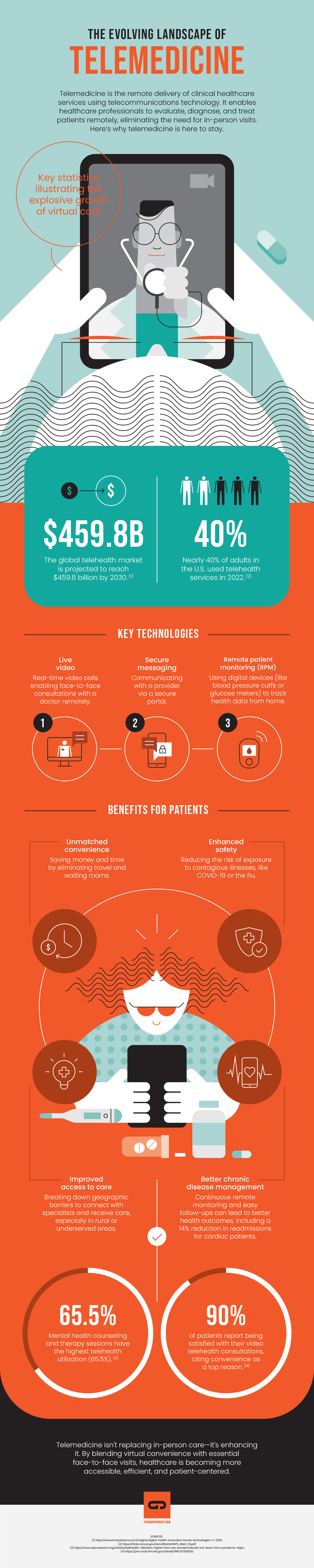
The scale of this shift is staggering: The global telehealth market is projected to reach $459.8 billion by 2030.(1)
How does telemedicine work?
This type of virtual care is typically delivered through a few key methods: real-time video consultations, secure messaging via patient portals, and remote patient monitoring (RPM), which uses digital devices to track vital signs, like blood pressure, from a patient’s home.
A win-win for patients and providers
This technological shift offers a win-win for both sides of the care equation. Patients can gain unmatched convenience, saving travel time and money, and improved access to specialists while reducing exposure to illnesses in waiting rooms. Providers can see greater efficiency, reduced patient no-shows, and lower operational costs. The clinical impact is also significant, contributing to better patient outcomes, like a 14% reduction in readmissions for cardiac patients. It’s no surprise that 90% of patients report satisfaction with their video telehealth experiences.(4)
The highest utilization of telemedicine has been in mental health services, accounting for 65.5% of use, followed by routine follow-ups, urgent care for minor issues, and chronic disease management.(3)
The next wave: AI and intelligent monitoring
The evolution of telemedicine is far from over. The next wave is being driven by intelligent systems. For example, artificial intelligence (AI) is already helping clinicians analyze medical images with greater speed and accuracy, while generative AI can automate clinical notes,
freeing doctors to focus on patients. RPM is also advancing beyond simple data tracking, now using smart wearables and at-home sensors that provide a continuous stream of health data. AI algorithms can analyze this data to predict health crises before they become critical.
Jumping over critical hurdles
Despite this progress, the future of telemedicine depends on overcoming significant hurdles. The financial and regulatory landscape remains uncertain. Many flexible reimbursement policies enacted during the COVID-19 pandemic are temporary. In the U.S., crucial Medicare telehealth flexibilities are set to expire after September 30, 2025, creating a “policy cliff” that could roll back coverage for at-home and audio-only care without new legislation.(5)
Perhaps the most significant barrier, however, is the “digital divide.” A lack of broadband access and, more importantly, insufficient digital literacy threaten to widen health disparities, leaving older adults and rural populations behind.
Forging an integrated future
Successfully overcoming these challenges is the key to achieving a truly integrated, hybrid model of care. The future isn’t about replacing doctors’ offices entirely—it’s about building a seamless system where virtual care can enhance efficiency and access while in-person care is reserved for when it’s most needed. This blended approach promises a more resilient, equitable, and patient-centered healthcare system for all.
Sources:
- https://www.tmasolutions.com/insights/digital-health-innovation-trends-technologies-in-2025
- https://hints.cancer.gov/docs/Briefs/HINTS_Brief_53.pdf
- https://www.epicresearch.org/articles/telehealth-utilization-higher-than-pre-pandemiclevels-but-down-from-pandemic-highs
- https://pmc.ncbi.nlm.nih.gov/articles/PMC10783830/
- https://www.cms.gov/files/document/telehealth-faq-04-09-25.pdf
FAQ
Telemedicine is the delivery of clinical healthcare remotely, using technology such as video calls, secure messaging, and digital monitoring devices. What was once a niche service has grown into a cornerstone of modern medicine, fundamentally changing how patients and doctors interact.
Virtual care is typically delivered through three main methods: real-time video consultations, secure messaging via patient portals, and remote patient monitoring (RPM), which uses digital devices to track vital signs like blood pressure from a patient’s home.
The global telehealth market is projected to reach $459.8 billion by 2030, reflecting the massive shift toward digital healthcare that accelerated during and after the COVID-19 pandemic.
Patients gain convenience, save time and money on travel, get improved access to specialists, and avoid exposure to illness in waiting rooms. Studies show that 90% of patients report satisfaction with their video telehealth experiences, and telemedicine has been linked to a 14% reduction in hospital readmissions among cardiac patients.
Mental health services account for the largest share of telemedicine use at 65.5%, followed by routine follow-up appointments, urgent care for minor issues, and chronic disease management.
AI is already helping clinicians analyze medical images faster and more accurately, while generative AI can automate clinical documentation, freeing doctors to focus on patients. Smart wearables and at-home sensors connected to AI algorithms can now predict health crises before they become critical.
Two major hurdles stand out. First, regulatory and financial uncertainty, many flexible reimbursement policies introduced during the pandemic are temporary, and their expiration could roll back coverage for many patients. Second, the “digital divide”, a lack of broadband access and insufficient digital literacy, risks leaving older adults and rural populations behind, potentially widening existing health inequalities.
No. The goal is an integrated, hybrid model where virtual care handles routine and follow-up needs, while in-person visits are reserved for when they’re truly necessary. This blended approach aims to create a more efficient, equitable, and patient-centered healthcare system.