


Entertainment is no longer defined by one screen. While most are comparing cinema and streaming, there’s a third player being disrupted: television. There’s no space for all of them. Only some will thrive in the future landscape of storytelling.
Global Box Office Peaks and the Resilience of Theaters
Since the Lumière brothers, cinema has been constantly enriching the lives of millions. From early screenings in Gran Café in Paris and Hollywood blockbuster movies to European art cinema, cinema has transformed and evolved for over a century—and it doesn’t intend to stop.
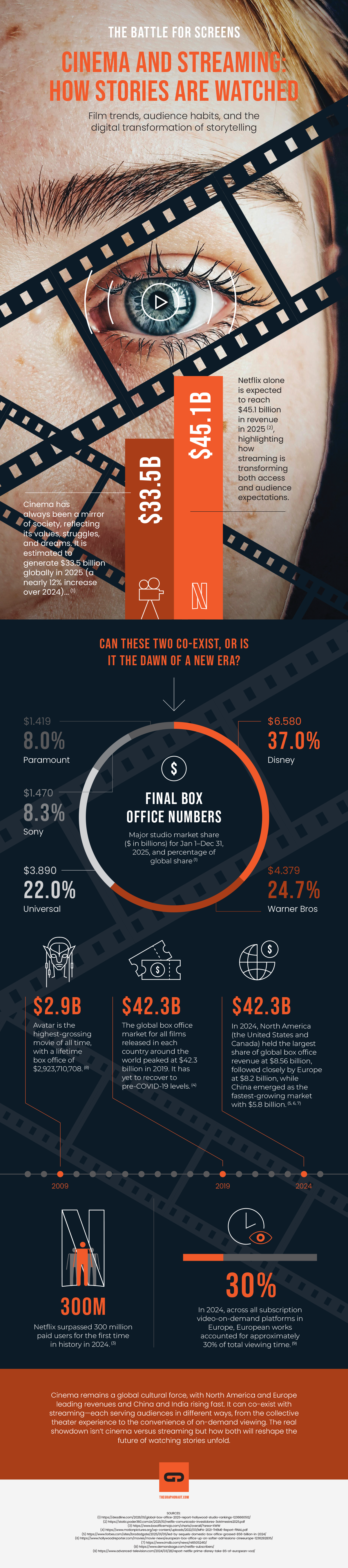
Cinema is still adapting and growing. In Europe, admissions rose to 986 million visits and €7.2 billion in box office revenue in 2023, nearing pre-pandemic levels, with many markets surpassing or matching their 2017–19 averages. (1)
At the same time, while Disney and Pixar’s Inside Out 2 movie became the most successful animated film of all time and fastest to cross the $1 billion global box office, in France, almost half the cinema tickets sold in 2024 were for French films. (2, 3)
It shows cinema’s resilience, durability, and versatility.
Streaming Growth and the Shift in Audience Habits
Streaming platforms have reshaped the market in a way cinema and television haven’t experienced in decades. “Netflix and chill” has become a world-known phrase. Disney+, which launched in 2019, now has more than 120 million subscribers worldwide, while Amazon Prime Video serves more than 240 million members globally. (4, 5)
Top Netflix shows include some old gems, like Arrested Development, Breaking Bad, and Brooklyn Nine-Nine, but also Guy Ritchie movies, One Hundred Years of Solitude, Peaky Blinders, the Lupin series, or reality series, like Love Is Blind.
The best shows on Disney+ include classics, like The Simpsons, Family Guy, and How I Met Your Mother, as well as popular entries in the Star Wars universe, such as The Mandalorian and Andor.
On Amazon Prime Video, audiences turn to hits like The Boys, Jack Ryan, The Marvelous Mrs. Maisel, and Reacher, which consistently rank among the platform’s most-watched and most-searched series.
In short, streaming services focused on quality and variety, and the payoff is clear in the way audiences now favor on-demand viewing over traditional screens.
Infographic design by Boris Benko
Television Under Pressure: The Next Big Disruption
Cinema remains a global cultural force, with North America and Europe leading revenues, and China and India rising fast. But while streaming has already matched cinema in reach and revenue, the real disruption is happening to television, where paid streaming services are forecast to achieve a 37% increase in revenue to €38.4 billion by 2029, compared to modest growth for public broadcasters. (6)
Traditional linear TV ad spending in Europe is forecast to decline at a -1.5% annual rate, sliding from $28.6 billion USD in 2025 to around $26.6 billion by 2030. (7)
Yet, television still shines during major live events. For instance, the Euro 2024 final drew a peak audience of 24.2 million across ITV and BBC, with an average of 22.3 million viewers. (8) In France, the Olympic opening ceremony in Paris set records with 24.4 million TV viewers, including 1.2 million on VOD platforms—trumping even the 2022 World Cup final. (9)
The Future of Screens: Coexistence or Takeover?
The story of the future isn’t cinema versus streaming—it’s streaming overtaking TV, while cinema adapts alongside both. Theaters continue to offer a collective cultural experience, while streaming expands with convenience and global reach. Television, however, faces the steepest decline, surviving mainly through live events.
In this shifting landscape, cinema adapts, streaming grows, but TV faces the greatest challenge.
Sources:
- https://unic-cinemas.org/en/resources/news/news-blog/detail/unic-publishes-its-2024-annual-report-and-elects-a-new-board-of-directors-at-cineeurope/
- https://people.com/inside-out-2-billion-box-office-record-2024-8671991
- https://www.theguardian.com/world/2025/jan/10/comedy-and-the-count-of-monte-cristo-french-flock-to-cinemas-to-watch-homegrown-films
- https://www.statista.com/statistics/1095372/disney-plus-number-of-subscribers-us/
- https://evoca.tv/amazon-prime-statistics/
- https://www.ampereanalysis.com/insight/streaming-revenue-overtakes-public-tv-in-europe
- https://www.statista.com/outlook/amo/advertising/tv-video-advertising/traditional-tv-advertising/europe
- https://www.itv.com/presscentre/presscentre/media-releases/euro-2024-final-watched-peak-242-million-tv-across-itv-bbc
- https://www.lemonde.fr/en/economy/article/2024/08/06/whether-viewership-or-terabits-the-paris-olympic-games-are-breaking-records_6710415_19.html